

Graphy 3D-Printed Shape Memory Aligner Demonstrates Attachment-Free Rotation Correction
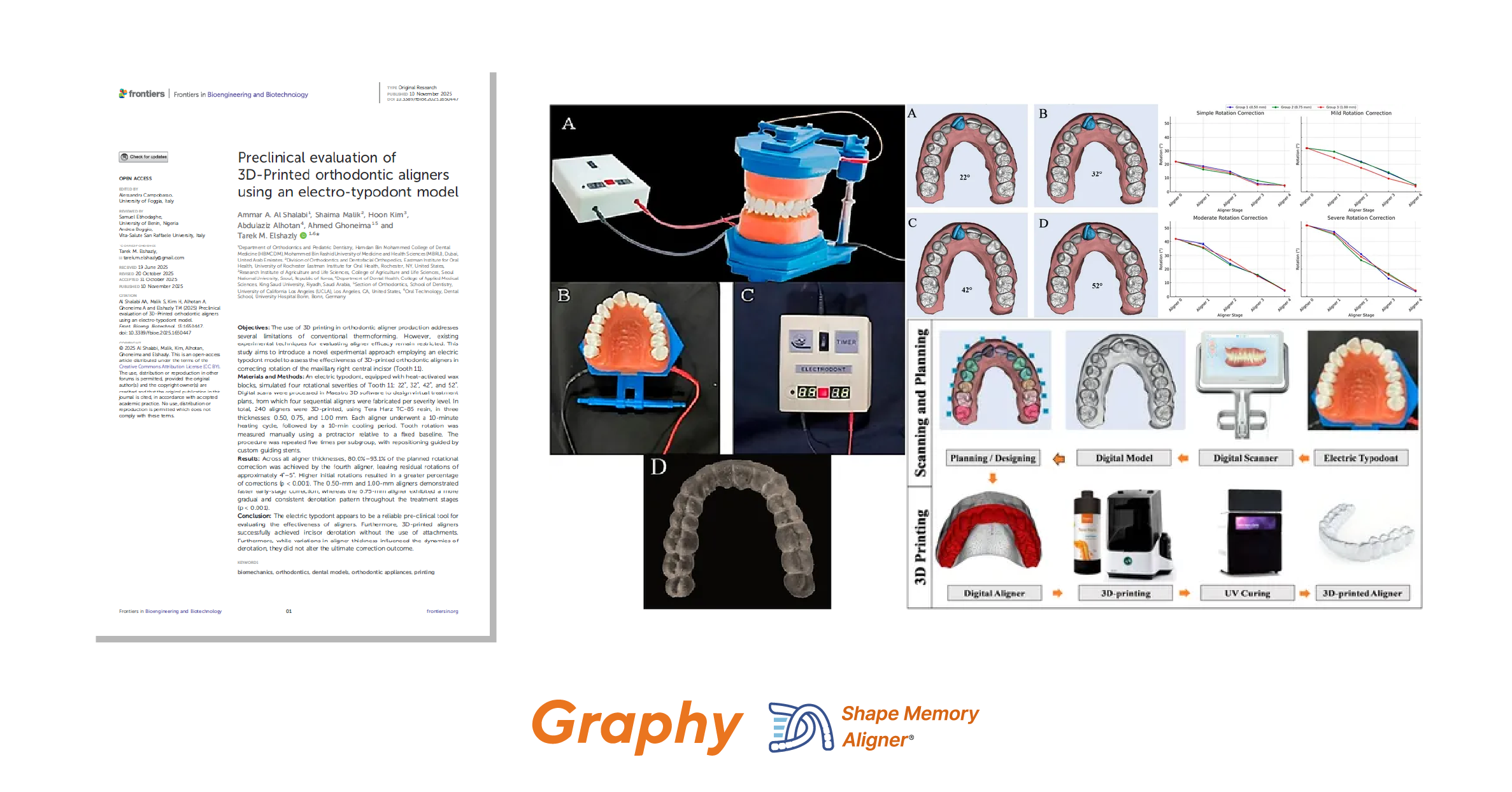
The study evaluates 3D-printed aligners using an electro-typodont model, demonstrating controlled rotational tooth movement and validating Graphy’s material technology.

Corporate and brand identities of Graphy and the world’s first direct 3D-printable Shape Memory Aligner® — a game-changer in digital orthodontics.
– Joint Study by Graphy Inc. and the University of Bonn (Germany)
The paper, titled “Preclinical Evaluation of 3D-Printed Orthodontic Aligners Using an Electro-Typodont Model,” presents a standardized preclinical framework for assessing the tooth-movement efficiency of 3D-printed clear aligners. The study demonstrated that Graphy’s 3D-printed shape memory aligners (TC-85 resin), achieved high rotational correction efficiency.
Led by Prof. Tarek M. Elshazly of Bonn University, the international research team included Dr. Hoon Kim, Principal Researcher at Graphy Inc., as a co-author, with additional collaboration from Seoul National University (SNU, Korea), King Saud University (Saudi Arabia), Mohammed Bin Rashid University of Medicine and Health Sciences (MBRU, United Arab Emirates), and the University of California, Los Angeles (UCLA, United States).
In the experiment, the team used a specialized electro-typodont model equipped with a heat-regulated wax matrix simulating periodontal tissues. The upper central incisor (tooth #11) was rotated by 22°, 32°, 42°, and 52°, and aligners were fabricated directly 3D printing Graphy’s SMA resin (TC-85). For each rotation degree, four sequential aligners were designed and printed in three thicknesses (0.50 mm, 0.75 mm, and 1.00 mm), totaling 240 aligners, with five repeated measurements per condition for reproducibility.
Results showed that after the fourth aligner in each sequence, 80.0–93.1% of the planned rotational displacement was recovered, leaving only 4–5° of residual rotation. Interestingly, higher initial rotation angles resulted in greater relative recovery ratios. Aligner thickness influenced the rate of movement rather than the total recovery:
• 0.50 mm and 1.00 mm aligners produced faster initial responses,
• while 0.75 mm exhibited smoother and more consistent recovery throughout all stages.
Notably, no attachments were used during the experiment, confirming that directly 3D-printed SMAs can achieve substantial rotational corrections independently.
The Bonn University team concluded that the electro-typodont model provides a reliable preclinical tool for evaluating the mechanical performance of 3D-printed aligners before clinical use. They further noted that the direct-printing approach, combined with Graphy’s shape memory material, overcomes limitations seen in thermoformed PETG aligners and establishes a new paradigm for digital orthodontics.
Graphy’s Shape Memory Aligner (SMA) is formulated with a urethane-acrylate oligomer base, and its shape memory response is engineered to activate within body-temperature range. This enables the material to continuously exert controlled orthodontic forces by restoring its original geometry inside the oral cavity. Unlike thermoformed aligners, which suffer from edge weakening and thickness reduction, Graphy’s shape memory aligners preserve the digital design’s precision while providing durable, predictable force delivery.
This preclinical research provides a robust and standardized validation of Graphy’s direct-printed aligner system, demonstrating measurable and reproducible tooth correction beyond theoretical or clinical claims. The collaboration between Graphy and Bonn University began in November 2022 and has since evolved into an ongoing program investigating the mechanical and biomechanical properties of shape-memory aligner materials. This study marks another tangible outcome of that partnership.
________________________________________
[Clinical Relevance: Bridging Preclinical Evidence and Real-World Outcomes]
Although this study represents a preclinical validation, it complements the extensive clinical evidence already accumulated by Graphy worldwide. With over 200,000 clinical cases, Graphy’s SMA technology has demonstrated effective control in rotation, extraction-space closure, and complex tooth movements previously unattainable with conventional thermoformed aligners.
The Bonn collaboration thus serves as a scientific foundation supporting those clinical achievements—showing that Graphy’s SMA mechanism maintains consistent performance under standardized laboratory models as well. This alignment between clinical predictability and scientific validation reinforces Graphy’s position as a pioneer in direct 3D-printed orthodontic systems, advancing the global standard for digital orthodontic care.
Paper Information: https://doi.org/10.3389/fbioe.2025.1650447
Bob Lee
Graphy inc.
+ +1 888-616-2764
email us here
Visit us on social media:
LinkedIn
Instagram
Facebook
YouTube
About Graphy: Shaping the Future with Vision
Legal Disclaimer:
EIN Presswire provides this news content "as is" without warranty of any kind. We do not accept any responsibility or liability for the accuracy, content, images, videos, licenses, completeness, legality, or reliability of the information contained in this article. If you have any complaints or copyright issues related to this article, kindly contact the author above.
