

Photoelectric and Inductive Sensor Options from PFTWORLD, a Leading Sensor Manufacturer from China
Photoelectric Sensors Detect Objects Through Optical Interaction Rather Than Metal Response
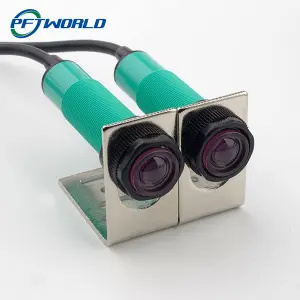
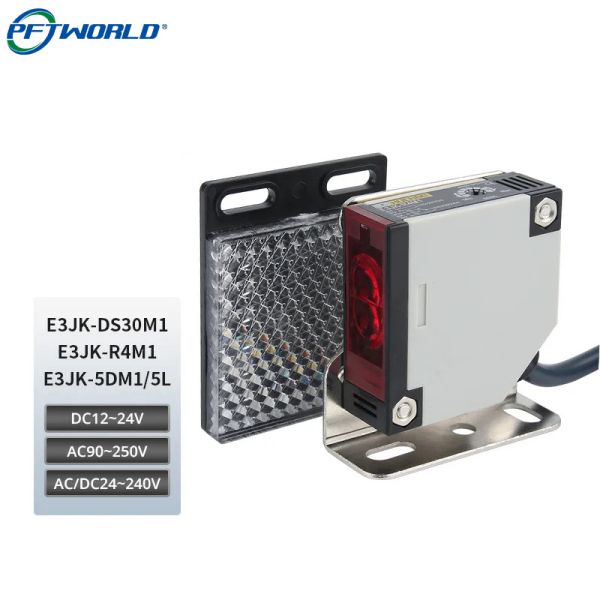
PFTWORLD’s photoelectric sensors utilize optical detection, differing completely from inductive models. Inductive models detect only metals, whereas photoelectric sensors emit infrared or visible light beams to determine presence based on light blocking or reflection. This proves essential for packaging, material handling, and assembly operations where targets are plastic, cardboard, glass, or non-metallic. Optical detection verifies presence without requiring targets to generate electromagnetic responses.
In a diffuse setup, the sensor relies on the target to bounce light back. Specular-reflection requires a dedicated reflector, ensuring reliable detection of shiny or irregularly shaped items. With models designed for transparent targets, engineers deploy photoelectric sensing in glass or clear plastic processing where standard beams fail.
Optical mode, target reflectivity, detection distance, and installation geometry remain model-specific. Therefore, one product’s characteristics cannot be generalized across the catalog. A sensor calibrated for short-range diffuse detection requires different lens specifications than a long-range specular-reflection model. Engineers must evaluate target reflectivity and match it with the correct optical mode while recognizing that ambient light, dust, and vibration affect each configuration differently.
E3F-5D Provides a Defined Infrared Photoelectric Switch Example
The E3F-5D provides an industrial photoelectric sensor example featuring infrared detection and an opposed AC configuration. This model demonstrates integrating optical sensing into physical layouts. The opposed configuration—with emitter and receiver in separate housings facing each other—creates a robust through-beam that the target object must break. This approach overcomes environments where heavy dust or debris interfere with standard reflected signals.
Described as an infrared induction photoelectric switch for non-contact detection, the E3F-5D supports applications where optical beams establish presence. Infrared light operates outside the visible spectrum, minimizing interference from factory lighting or sunlight. This non-contact mechanism allows high-speed operation without inducing mechanical wear on the target or sensor, making the E3F-5D ideal for fast-paced sorting lines and vehicle detection systems where mechanical limit switches degrade.
Its 220 V and electrical specifications remain tied strictly to this product example. The 220 V AC specification indicates compatibility with control cabinets and relay logic systems operating on alternating current. However, industrial portfolios also feature 12 V or 24 V DC options for programmable logic controller (PLC) integration. The E3F-5D’s electrical parameters represent just one available path.
Inductive Sensing Is the Dedicated Route for Contactless Metal Targets
PFTWORLD’s LJ18A3-8-Z/BX illustrates the inductive portfolio branch, utilizing electromagnetic proximity principles for metal-object detection. Unlike optical sensors, inductive sensors generate a high-frequency oscillating electromagnetic field. When a metallic object enters this field, it induces eddy currents that dampen the oscillation and trigger the output. This principle makes inductive sensors immune to dust, oil, and opaque particulate matter that blind optical sensors, ensuring reliable detection in CNC machining centers, stamping presses, and automotive assembly cells.
This model features a normally open, NPN, three-wire configuration, providing defined switching parameters for controller integration. A normally open (NO) configuration keeps the output circuit disconnected until a metal target is detected. The NPN logic dictates that the sensor sinks current to ground when activated, ensuring compatibility with PLC input cards. The standard three-wire design—positive supply, negative common, and signal wire—establishes a stable electrical foundation.
The 8 mm sensing distance applies specifically to the LJ18 example and cannot directly compare with photoelectric through-beam models. Inductive ranges are governed by coil diameter and metal type; ferrous metals yield maximum range, while aluminum reduces effective distance. An 8 mm range perfectly suits close-quarters mechanical verification.
Electrical Output and Controller Compatibility Decide Viability
PFTWORLD’s options use different supply and output arrangements, making electrical compatibility a top priority. A sensor matching physical requirements remains useless if its electrical output cannot communicate with the control system. Engineers must verify available power—whether a low-voltage DC rail or higher-voltage AC line—and match the sensor rating. Failing to align specifications with the control architecture causes component damage, false triggering, or system failure.
A model may meet detection requirements but fail if its voltage, NPN/PNP logic, or normally open/closed behavior misaligns. Control systems utilize sinking (NPN) or sourcing (PNP) inputs; incorrect sensor logic prevents the PLC from registering signals. Installing a normally closed sensor when safety logic demands normally open will invert expected machine behavior. Wiring arrangements, such as pre-wired cables or M12 connectors, must also match facility standards.
The E3F-5D and LJ18 examples prove model-level electrical data must be verified individually. The 220 V AC configuration of the E3F-5D serves entirely different architectures than the 24 V DC NPN logic of the LJ18A3-8-Z/BX. Buyers must consult individual data sheets for voltage, load current, and switching frequency to guarantee safe function.
OEM/ODM Inputs Adapt Sensors Around the Application Envelope
PFTWORLD’s OEM/ODM customization covers size, material, output type, and environmental requirements. While standard catalogs cover most applications, specialized equipment frequently imposes unique constraints. Manufacturers designing compact medical devices or high-temperature injection machines may require non-standard thread lengths, specialized housings, or custom cables. The OEM/ODM workflow allows buyers to specify exact parameters to fit proprietary machinery.
Customization addresses installation space, housing material, signal format, and ambient conditions. A food processing application may demand an inductive sensor with 316L stainless steel housing and IP69K ratings for washdowns, while an automated guided vehicle (AGV) requires an ultra-low-profile photoelectric body. This process lets engineers dictate connector types, temperature ranges, and switching frequencies for seamless integration.
Customization must preserve model validation: changing form factors alters performance specifications. If an OEM requests a smaller inductive housing, the internal coil diameter shrinks, reducing maximum sensing distance. Modifying photoelectric voltages can change switching speeds or optical intensity. Buyers must respect physical laws governing their chosen sensing principle, ensuring customized sensors undergo rigorous validation testing.
Target, Optical Conditions and Electrical Interface Drive Final Selection
PFTWORLD separates optical object detection from inductive metal proximity sensing to ensure principles match target and installation conditions. This categorization prevents misapplication, requiring engineers to evaluate the object's fundamental nature. Non-metallic, transparent, or distant targets mandate optical sensing. Conversely, metal targets in heavily contaminated environments demand inductive reliability.
Buyers must identify target material, transparency, sensing distance, voltage, output logic, mounting space, and ambient conditions. This systematic approach ensures accurate, long-term performance. For example, highly reflective metal targets might trigger specular-reflection sensors erratically, favoring inductive solutions. Evaluating ambient conditions like cutting fluids or vibration further narrows viable technologies.
Product examples should be compared alongside OEM/ODM customization requirements. Understanding baselines like the E3F-5D and LJ18A3-8-Z/BX establishes benchmarks. Clear separation of sensing principles and electrical interfaces reduces selection errors. For more information on proximity and optical detection technologies, visit https://www.pftworld.com/
Shenzhen Perfect Precision Products Co., Ltd.
PFTWORLD
email us here
Visit us on social media:
Instagram
Facebook
YouTube
X
Legal Disclaimer:
EIN Presswire provides this news content "as is" without warranty of any kind. We do not accept any responsibility or liability for the accuracy, content, images, videos, licenses, completeness, legality, or reliability of the information contained in this article. If you have any complaints or copyright issues related to this article, kindly contact the author above.
