

Scaling up European firms: the case for an EU company law regime to unlock cross-border investment, innovation and growth
Prepared by Adam Baumann, Zakaria Gati, Daphne Momferatou, Laura Parisi and Lucia Quaglietti
1 Introduction
There is a clear structural weakness at the heart of Europe’s competitiveness challenge: European firms struggle to reach sufficient scale and face barriers to cross-border operations. EU firm entry rates are broadly comparable to those in the United States, but firms systematically fail to grow into the large, research and development (R&D) intensive enterprises that drive productivity and wage growth (Draghi, 2024, Letta, 2024). In addition, some observers argue that Europe focuses on incremental rather than breakthrough innovation (Fuest et al., 2024).
A specific dimension of this competitiveness challenge is the fragmentation of company law across the EU. Firms operating across borders in the EU must navigate multiple legal regimes, which can limit cross-border capital formation, innovation, investment and economic growth (Schnabel, I., 2026). To address this, in March 2026 the European Commission proposed introducing an optional corporate form (EU Inc.), establishing a harmonised legal framework to complement national company law.
This proposal is important from the ECB’s perspective. By lowering barriers to cross-border corporate activity and investment, EU Inc. has the potential to support the Single Market, by strengthening competition, innovation and productivity growth, with positive implications for resource allocation, price stability and the transmission of monetary policy. In addition, EU Inc. can help deepen European capital markets, a key objective of the savings and investments union agenda. It could be conducive to a more efficient allocation of savings and more effective risk-sharing within the euro area.
This article examines how these barriers limit the ability of EU firms to scale up and explores how a single company law could help address them. It identifies the conditions under which the proposal could have a meaningful impact as well as the gaps that, if left unaddressed, may limit its effectiveness.
2 The European scale-up challenge: stylised facts
Europe creates firms but struggles to scale them up, with consequences for productivity. While annual firm birth rates in Europe are similar to those in the United States, at around 10% per year (Adilbish et al., 2025), a significant divergence emerges later on, when successful firms seek to expand, raise capital and operate across borders.[1] Firms that employ fewer than ten workers in the EU account for just over 20% of total employment, around double the share of that in the United States (Chart 1, panel a). This is important for labour productivity (Chart 1, panel b): large enterprises generate roughly twice as much value added per employee as micro-enterprises, benefiting from economies of scale, greater managerial specialisation, stronger intangible capital accumulation, higher R&D expenditure and better integration into international markets (Andrews et al., 2016, Eurosystem, 2021, CompNet, 2025, OECD, 2026). A counterfactual exercise suggests that around one-third of the aggregate EU-US productivity gap can be attributed to differences in firm-size composition, based on the productivity gains that would arise were the EU to have the same employment distribution across firm sizes as that of the United States.[2]
Chart 1
Firm size distribution and labour productivity by firm size in 2023
a) Size distribution, EU and United States
(percentage of total employment)

b) Labour productivity by enterprise size, EU
(EUR thousands per person employed)

Sources: Eurostat business demography statistics and structural business statistics and US business dynamics statistics.
Notes: EU data refer to enterprises and US data to firms, which are broadly comparable. Coverage includes NACE Rev. 2 sections B-S (excluding O and S94). Labour productivity is measured as value added at factor cost per person employed.
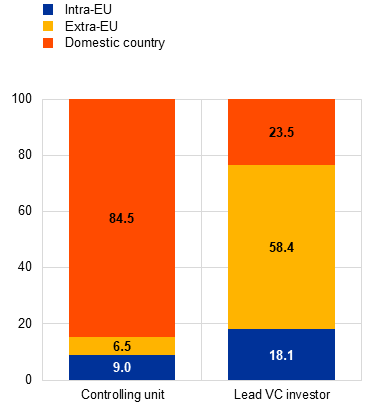
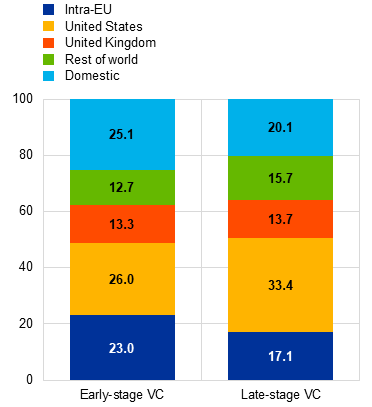
Limited access to market-based finance is a major reason why innovative European firms struggle to scale up. Innovative firms need successive funding rounds and access to deep pools of risk capital, but EU capital markets remain relatively shallow, nationally fragmented and dominated by domestic institutional investors (Böninghausen et al., 2025, Baumann et al., 2026). Chart 2, panel a) shows that approximately 85% of employment in the EU is accounted for by domestically-controlled firms. By contrast, venture capital (VC) financing is considerably more international: non-EU lead investors are associated with more than half of the aggregate VC deal value, with US investors playing a particularly important role in later-stage financing rounds (Chart 2, panel b), (Baumann et al. 2026). This is consistent with recent evidence that innovative European firms increasingly relocate their headquarters, intellectual property or selected business functions abroad, most often to the United States (Weik et al., 2024, European Investment Bank (EIB), 2026a). As firms mature, many European start-ups adopt US corporate structures, most commonly as Delaware corporations, to access internationally recognised governance arrangements, VC financing and deeper initial public offering markets. The Delaware corporate law framework is discussed in Box 1.
Chart 2
Source of control and venture capital financing of EU firms
a) Overall distribution in origin of control and venture capital lead investor |
b) Venture capital lead investor by deal stage |
|---|---|
(percentage of employment; percentage of value) |
(diffusion indices) |
 |
 |
Sources: Eurostat inward foreign affiliates statistics and PitchBook.
Notes: In panel a), inward foreign affiliate trade statistics classify enterprises by the country of their ultimate controlling institutional unit, attributing all employment to the controlling country. Intra-EU and extra-EU values denote control by another EU Member State and from outside the EU respectively. The latest data are for 2023. Panel b) shows the distribution of venture capital deal value by the location of the lead (or sole) investor and the VC stage. PitchBook may report multiple lead or sole investors for a transaction.
Beyond the overall availability of risk capital, where it is allocated also matters: future scale-ups tend to be younger, more productive and more innovation-intensive, while there are substantial differences in the profiles of VC-backed scale-ups in the EU and the United States. With regard to the observed characteristics of firms before scaling up, Chart 3, panel a) shows that future scale-ups are systematically younger, more productive, more likely to have previously received venture capital and more frequently active in knowledge-intensive sectors. This is consistent with the literature showing that successfully scaling up is typically preceded by substantial investments in capabilities and organisational transformation (OECD, 2021). Chart 3, panel b) extends this analysis to a sample of EU and US scale-ups that received VC funding. Relative to their EU counterparts, VC-backed scale-ups in the United States are younger and less profitable, but larger in terms of employment and more leveraged – a pattern consistent with US venture capital reaching firms earlier and those firms then growing faster. This may reflect differences in investor selection or differences in the population of firms seeking VC funding, which the estimates cannot separate.
Chart 3
Firm characteristics associated with scaling up
a) Characteristics before scaling up
(odds ratios)

b) Difference in characteristics for EU and US scale-ups that received VC funding
(odds ratios)

Sources: S&P Capital IQ, Preqin, Orbis, PitchBook and ECB staff calculations.
Notes: Coefficients from logistic regressions with 95% confidence intervals; covariates are standardised. In panel a), scaling up is defined as annualised employment growth of at least 10% over three years, for firms with at least ten employees and more than one year old. Covariates are measured one year before the scale-up period, with year, country and sector fixed effects. “Received VC” (Preqin deal data matched to Orbis) refers to one to three years before the scale-up period. ICT is defined from NACE two-digit activities. Covariates are winsorised at 2%. Panel b) shows a logistic regression of an indicator for US (vs EU) headquarters on standardised firm characteristics, with sector and year fixed effects. It features a PitchBook sample of 962 US and EU scale-ups in 2025 that received VC funding in 2021-24; the estimation is based on 2021-22 observations. “Return on assets” is measured as earnings before interest, taxes, depreciation and amortisations over total assets.
Box 1
The Delaware stock corporation regime: legal infrastructure for US high-growth firms
Prepared by Zakaria Gati
In the United States, incorporation can be separated from the location of economic activity to a far greater extent than in the EU, allowing state corporate law to operate as a portable legal framework for firms active across the country. This contrasts with the European tradition of “real seat” approaches, under which legal recognition and applicable company law were historically linked more closely to the company’s central administration or principal place of business, as pointed out by Gelter (2017).[3] A Delaware stock corporation may be headquartered, hire workers, hold assets, raise capital and generate revenues outside Delaware, whereas Delaware law governs its internal corporate affairs. The firm remains subject to operational, tax, labour and sectoral regulation in the jurisdictions where it operates businesses, but it does not need to adopt a new legal identity. This portability helped make Delaware the standard corporate law framework – or what Broughman et al. (2014) call a legal “lingua franca” – for founders, investors and legal intermediaries operating across state lines. In the EU, cross-border mobility is already protected by freedom-of-establishment case law, but firms remain incorporated under one of many national company law regimes.
The Delaware regime is distinctive not because it allows a single corporate form, but because it offers a complete institutional ecosystem for company formation and growth. At its core is the Delaware stock corporation, supported by flexible laws, specialised courts, extensive case law, efficient administration and a sophisticated legal services industry. This combination provides legal certainty and standardised governance and financing tools – such as preferred shares, options, convertible securities, liquidation preferences, veto rights and board representation – making Delaware a common template for start-ups, scale-ups and geographically dispersed investors.
The attractiveness of the regime is clear: Chart A, panel a) shows the sustained growth in the share of high-propensity business applications made in Delaware, and Chart A, panel b) illustrates the large number of legal entities already administered in the state. Additionally, Delaware incorporation becomes increasingly prevalent as firms scale up: Broughman et al. (2014) find that 67.8% of VC-backed start-ups were initially incorporated in Delaware. This rises to 79% once subsequent re-incorporations are taken into account. Alon-Beck (2025) finds that around 97% of US unicorns in their sample were incorporated in the state, and Chart A, panel c) shows that more than half of publicly traded US companies are incorporated in Delaware. Delaware’s dominance is also self-reinforcing owing to its increasing precedents and familiarity, and it now effectively operates as a national standard.
Chart A
Business demographics in Delaware
a) High-propensity business applications in the United States |
b) Breakdown of entities incorporated in Delaware by legal form (2025) |
c) Share of publicly traded US stock companies incorporated in Delaware |
|---|---|---|
(index: 2005:1 = 100) |
(thousands of entities) |
(percentage points) |
 |
 |
 |
Sources: US Census Bureau, Annual Report Statistics – Delaware Division of Corporations, Spamann and Wilkinson’s dataset of historical states of incorporation of US stocks and ECB staff calculations.
Notes: High-propensity business applications are employer identification number applications that the US Census Bureau identifies as being likely to become employer businesses, based on characteristics associated with payroll business formation (e.g. legal form, planned hiring, business acquisition and industry). The data are seasonally adjusted. In panel c), the state of incorporation is from Spamann and Wilkinson using filings from the US Securities and Exchange Commission’s electronic data gathering, analysis and retrieval system. It refers to the legal domicile, not to the headquarters or business operations.
The advantages for firms incorporating in Delaware come with important trade-offs. Critics argue that this concentrated ecosystem can favour managers, controlling shareholders and repeat-player lawyers, limiting transparency and accountability (Cary, 1974, Whitehead, 2025). Recent cases of entities leaving Delaware for Nevada and Texas also illustrate the tension between healthy regulatory competition and regulatory arbitrage, as firms may seek lower litigation exposure and weaker shareholder constraints.
3 Barriers to scaling up and EU Inc.: a corporate life cycle perspective
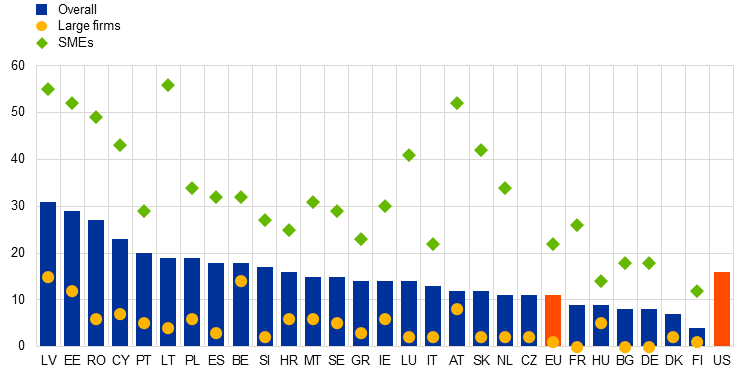
EU firms face a broad set of legal and regulatory barriers that increase the costs of growth and cross-border expansion within the Single Market.[4] Survey-based evidence indicates that, compared with the United States, regulatory and administrative requirements are a major obstacle to investment and a sizeable burden for EU firms (Chart 4, panel a). The share of staff and managerial resources devoted to compliance activities also varies significantly across EU countries and can be especially high for smaller firms, as compliance costs have a substantial fixed-cost component (Chart 4, panel b). These costs are compounded by regulatory fragmentation across Member States, with most EU firms reporting that they must comply with different standards and procedures when operating across borders (EIB, 2026b).[5]
Chart 4
Structural barriers to investment for EU and US firms
a) Major obstacles to investment
(percentage of respondents)

b) Firms with more than 10% of employees working on regulatory compliance activities
(percentage of respondents)
Sources: EIB Investment Survey and ECB staff calculations.
Notes: In panel a), the bars represent the share of firms that identify each factor as a major barrier to long-term investment; the diamonds show the corresponding shares for SMEs. EU and US refer to the respective EIB Group Survey on Investment and Investment Finance aggregates. Higher values indicate that more firms perceive the factor as a major obstacle. In panel b), EU data refer to the 2025 survey and US data refer to the 2024 survey. Size breakdowns are unavailable for the United States.
Company law is one of the most fragmented dimensions of the Single Market. The legal regime under which a company is incorporated determines the financing instruments it can offer investors, the governance arrangements it must adopt as it operates and expands and the procedures it faces when exiting the market. Unlike many other regulatory areas, company law changes each time a firm establishes or reorganises a legal entity in another Member State, something which is often required, or economically advantageous, for companies establishing a stable presence in another Member State.[6] As a result, firms wanting to expand or invest across the EU must navigate the company law applicable to them and to their new subsidiaries, which can mean up to 27 different regimes. Differences in company law can increase the cost of operating across borders through subsidiaries and potentially limit investment, innovation and productivity growth.
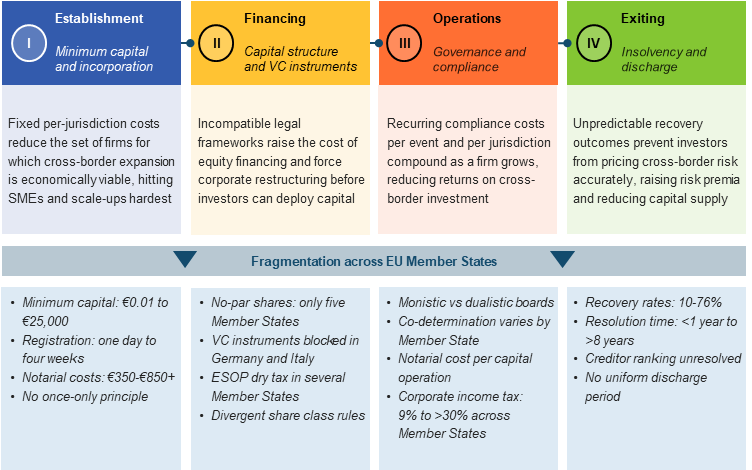
The economic implications of company law fragmentation across the Single Market can be best understood through the lens of the corporate life cycle (Figure 1).[7] National differences become binding constraints at successive stages of firms’ development. The European Commission’s 2025 public consultation confirmed this pattern, with firms perceiving fragmentation of company law as a significant obstacle throughout their development, with incorporation procedures, corporate mobility, financing arrangements and governance the most frequently cited issues.[8]
Figure 1
Company law fragmentation across the Single Market: a corporate life cycle perspective
Source: ECB staff.
Note: Minimum capital refers to the statutory capital required to incorporate a company; no-par shares are shares without a fixed nominal value; VC instruments are financing instruments commonly used in venture capital, such as convertible instruments and warrants; ESOP refers to employee stock ownership/option plans; monistic/dualistic boards refer to one-tier/two-tier corporate governance structures; co-determination refers to employee representation in corporate governance; and recovery rates, resolution time, creditor ranking and discharge periods capture key features of national insolvency frameworks. These examples illustrate differences across EU Member States.
In response, the Commission published on 18 March a proposal establishing a new corporate form, EU Inc. The proposed Regulation introduces a fully harmonised, optional legal form of limited liability company with a clearly identifiable label (EU Inc.) available across the national legal systems of all Member States. All companies in the EU, no matter their size or corporate purpose, will be able to opt in. As a directly applicable Regulation, it creates a single rulebook for some of the most relevant aspects of company law, with the same content and scope regardless of the Member State of incorporation.[9] Its objective is to reduce the fragmentation of company law and make the legal framework governing firms simpler and more conducive to establishment, investment and cross-border expansion. The proposal builds on the suggestions of the Letta and Draghi reports and follows past attempts that fell short of expectations, such as Societas Europaea.[10] The following sections analyse the proposal throughout the corporate life cycle.
3.1 Cross-border establishment
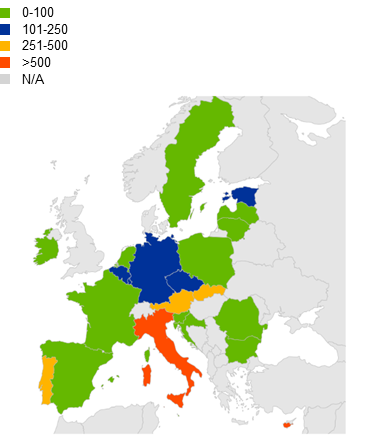
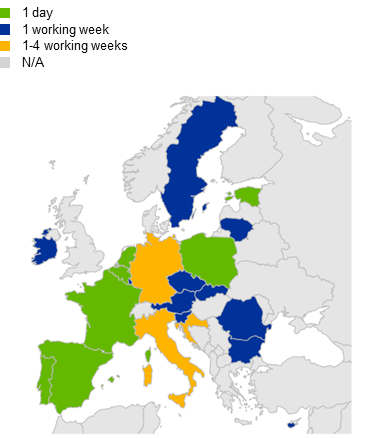
Establishing a legal presence in another EU Member State can entail substantial fixed costs (Figure 2). While firms can in principle serve another EU market without incorporating in that Member State, they often establish subsidiaries as new legal entities when they seek a stable local presence. In this case, fragmentation of company law becomes relevant, as the subsidiaries are incorporated under the law of the host country. This means that they have to adhere to different incorporation procedures and minimum capital rules while managing the associated administrative costs and the time required to establish a business.
Figure 2
Cost and time required to establish a new firm in 2025
a) Administrative costs to establish a start-up |
b) Time to establish a business |
|---|---|
(EUR) |
(days/weeks) |
 |
 |
Sources: Europe Startup Nations Alliance SNS Scoreboard and Natural Earth (for map data).
Notes: Values based on expert consultation, in the context of ultimately reaching a final committed company registration cost of under €100 and within one day for start-ups. The observations are for 2025.
To reduce these costs, the proposed Regulation introduces a simplified and harmonised corporate form. The form can be incorporated through a common digital interface, building on the Business Registers Interconnection System, with a target incorporation period of 48 hours and a maximum administrative cost of €100. The proposal removes mandatory minimum capital requirements, applies the once-only principle for administrative procedures and allows companies to establish an EU Inc. through several pathways, including new incorporation, cross-border mergers, divisions and conversions.
These measures could substantially reduce firms’ entry costs as well as the costs of expanding into other Member States, although the expected benefits will depend on how the measures are implemented in the Member States. They have the potential to reduce fixed entry, legal adaptation, contracting and compliance costs, and to lower the expected costs of future expansion by allowing firms to adopt the regime without changing their legal identity. Since the regime is open to all limited liability companies, it also avoids complicated eligibility criteria based on firm size or innovation status. However, EU Inc. firms remain subject to national tax, employer registration and licensing and sector-specific administrative requirements. Furthermore, incorporation and enforcement continue to rely on interconnected, albeit still national, company registers. As a further step, the European Commission plans to establish a central EU register from 2030 to gradually move registration away from the current country-based architecture.
3.2 Cross-border financing
National regimes differ in their treatment of equity instruments and employee stock options (Table 1). These differences increase legal complexity and can make some jurisdictions less compatible with VC financing models. This friction is particularly relevant for innovative firms, whose growth typically depends on successive rounds of equity financing involving changing investor rights and increasingly complex capital structures.
Table 1
Comparison of employee stock option frameworks across Member States
Employee tax rate |
Employee tax timing |
Employer taxation |
Minority shareholders and bureaucracy |
Plan scope |
Strike price |
|
|---|---|---|---|---|---|---|
EE |
||||||
LV |
||||||
LT |
||||||
FR |
||||||
PT |
||||||
DE |
||||||
CZ |
||||||
GR |
||||||
AT |
||||||
IT |
||||||
PL |
||||||
IE |
||||||
NO |
||||||
SE |
||||||
ES |
||||||
DK |
||||||
BE |
||||||
NL |
||||||
FI |
Sources: Not Optional Latest Country Rankings and ECB staff.
Notes: Not Optional, an initiative created by Index Ventures and some of Europe’s leading entrepreneurs to improve the competitiveness of European start-ups, scores the “friendliness” of national employee stock option regimes on a scale from one (least favourable – dark red) to five (most favourable – dark blue) across six dimensions: employee tax rate, employee tax timing, employer taxation, minority shareholders and bureaucracy, plan scope and strike price. More specifically, the “employee tax rate” is the applicable tax and social contribution burden; the “employee tax timing” defines when the tax liability is incurred; the “employer taxation” is the corresponding tax and social contribution costs for the company; the “plan scope” captures which companies and employees are eligible for favourable treatment; minority shareholders and bureaucracy” are the costs and constraints associated with creating the plan and with employees becoming minority shareholders and the “strike price” is the flexibility to set exercise prices below the latest financing valuation.
To address these constraints, the proposed Regulation introduces a harmonised financing framework applicable across all Member States. It allows no-par value shares, differentiated share classes, preferred equity, warrants and convertible instruments to be used while explicitly recognising financing arrangements commonly used in VC markets, such as Simple Agreement for Future Equity (SAFE) and Keep It Simple Security (KISS)-style instruments.[11] The proposal also establishes an optional European Employee Stock Ownership Plan (EU-ESOP), which is aimed at facilitating equity-based remuneration and improving firms’ ability to attract and retain highly skilled workers. In addition, it allows EU Inc. companies to seek admission to trading on a multilateral trading facility, supporting their capacity to scale up.
These provisions could improve financing conditions through two complementary channels. First, standardising financing instruments reduces legal uncertainty and transaction costs by limiting the need for jurisdiction-specific legal adaptations and facilitating the use of common investment documentation. The impact assessment conducted by the European Commission estimates savings of around €1,100 per financing round and between €1,780 and €2,850 for secondary share transfers. These gains are particularly relevant at the seed and early-growth stages, where fixed legal costs are large relative to deal size. A recognisable EU Inc. form and interconnected registers could also reduce screening and due diligence costs for non-domestic investors, facilitating greater cross-border participation in European VC markets. Second, the proposed EU-ESOP could improve the ability of firms to attract and retain talent by deferring taxation until the disposal of the underlying shares rather than at grant, vesting or exercise. This would reduce the cash burden associated with illiquid equity. Nevertheless, Member States would retain discretion over tax rates and the classification of employee equity income, while broader differences in eligibility conditions, valuation rules and administrative procedures would continue to limit the portability of employee stock ownership across the Single Market.
3.3 Cross-border operations
As firms expand across the Single Market, they encounter recurring compliance costs arising from differences in governance arrangements, shareholder rights and board structures across Member States.[12] Additional variation in co-determination, audit and reporting requirements further increases organisational complexity for firms operating in multiple jurisdictions.[13]
The proposed Regulation establishes a common governance framework applicable across all Member States. EU Inc. provides a high degree of contractual flexibility through harmonised articles of association and adopts a one-tier board structure as the default governance model. It also enables and standardises the use of digital-by-default processes for a broad range of corporate procedures, including shareholder meetings, capital operations and amendments to articles of association. The elimination of mandatory notarial intervention for capital operations could be significant for companies undertaking successive financing rounds as they grow, and harmonised rules on shareholder rights may reduce legal uncertainty for minority shareholders and external investors, lowering due diligence burdens and transaction costs. However, under the proposal, employee participation rules remain subject to the law of the Member State where the board is located. Requirements concerning the involvement of employees in company decision-making may therefore continue to vary across jurisdictions, even for companies incorporated under the EU Inc. regime.
3.4 Exit
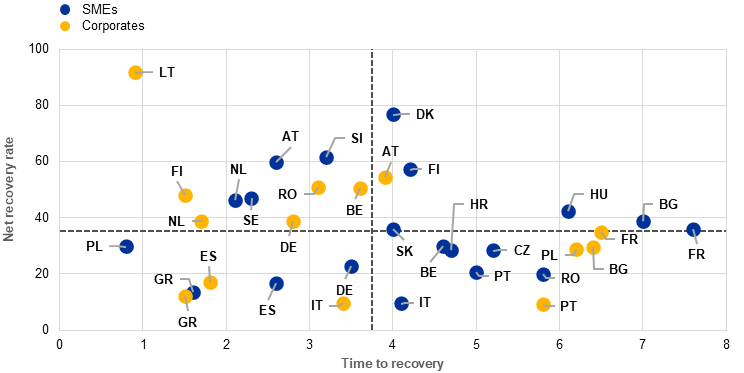
Efficient exit mechanisms are essential for reallocating resources following business failure and for supporting entrepreneurial risk-taking, as they determine the expected returns of investors. Exit and restructuring costs weigh heavily on innovative high-tech sectors, where the risk of failure is inherently higher (Coatanlem and Coste, 2025, Bothner et al., 2026). Nevertheless, national insolvency frameworks continue to differ substantially with respect to recovery rates, resolution times and entrepreneurial discharge (Chart 5). This increases legal uncertainty and could discourage cross-border investment.
Chart 5
Heterogeneity of insolvency across the EU for SMEs and corporates
(x-axis: years; y-axis: percentages)
Source: European Banking Authority (2025).
Notes: Net recovery rate and time to recovery are weighted means. Loans to SMEs and corporates subject to formal enforcement procedures, by country of enforcement; loans are weighted by the notional amount outstanding at the time of default. EBA underlying data are based on AnaCredit and dedicated bank data collections. Countries with fewer than 500 SMEs or ten corporate reported loans are excluded to ensure country averages are based on a sufficient number of observations. Dashed lines denote the cross-country medians. Observations are for the third quarter of 2023.
The proposed Regulation introduces fully digital and expedited liquidation procedures for solvent companies and establishes simplified insolvency arrangements for innovative start-ups. These include streamlined procedures and electronic auctions. These provisions can lower the administrative costs associated with corporate dissolution, improve procedural efficiency and increase the predictability of liquidation outcomes, reducing the uncertainty premium that investors currently attach to cross-border exposure. Faster and more transparent exit procedures may also lower the costs associated with business failure, facilitate entrepreneurial re-entry and improve the reallocation of capital and labour towards more productive uses. Armour and Cumming (2008) show that more efficient exit regimes have a positive effect on self-employment and firm entry rates, suggesting that improvements in exit efficiency feed back into the upstream decision to start and scale up high-risk ventures.
At the same time, the proposal leaves much of the European’s broader exit environment unchanged. Here, the Regulation takes a more targeted approach compared with the rest of the provisions discussed above, which are open to all firms opting to register as an EU Inc. The simplified insolvency framework applies only to innovative start-ups, leaving most firms subject to existing national regimes. Furthermore, insolvency procedures, creditor hierarchies and judicial processes largely continue to be governed by national legislation, implying that the considerable heterogeneity in recovery rates and resolution times is likely to persist.
At the other end of the firm life cycle, the proposal does not address obstacles that prevent successful firms from scaling up and exiting through public equity markets. The proposal establishes access to multilateral trading facilities, which are particularly important for younger firms, but it does not provide an equally integrated pathway to regulated markets for firms that are maturing and require deeper pools of capital. Leaving such access to the competence of national law does not address fragmentation at the scale-up and exit stage, potentially constraining IPOs and weakening VC exit opportunities and valuations.
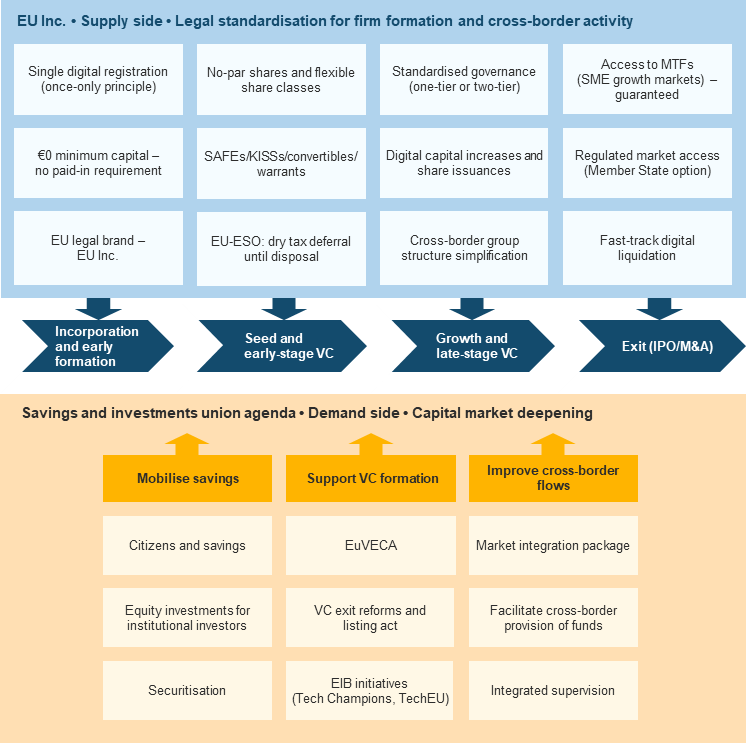
The financing provisions of EU Inc. complement the objectives of the savings and investments union more broadly. EU Inc. seeks to reduce legal frictions that affect the ability of firms to access external equity by creating a harmonised corporate framework. The savings and investments union aims to mobilise savings and improve the allocation of risk capital by deepening and integrating capital markets. In this sense, EU Inc. supports the supply of investible corporate vehicles, while the savings and investments union seeks to expand the demand for cross-border investment.
Figure 3
Interactions between EU Inc. and the savings and investments union agenda
Source: ECB staff.
This complementarity is particularly evident in VC markets. By reducing legal transaction costs and standardising corporate financing instruments, EU Inc. lowers the barriers to cross-border investment and facilitates more integrated capital markets. However, its effectiveness ultimately depends on the availability of investors willing to deploy capital across borders. Conversely, a deeper and more integrated European capital market is likely to succeed when firms operate under a common corporate framework. This is especially true for alleviating the financing gap during the later stages of firm development in Europe, where opportunities are limited by fragmented public equity markets and relatively shallow secondary markets. EU Inc. and the savings and investments union should be seen as mutually reinforcing initiatives: one reduces company law fragmentation while the other expands the pool of capital to finance growth.
4 Conditions for the economic effectiveness of EU Inc.
EU Inc. will operate as an optional corporate regime alongside existing national company law frameworks. Quantifying its macroeconomic impact is beyond the scope of this article, since its effectiveness will depend on firms’ adoption decisions and complementary policy reforms. Nevertheless, International Monetary Fund simulations suggest that reforms reducing barriers to firm entry and improving insolvency frameworks can generate sizeable economic gains (Dizioli et al., 2026).
A first condition for success is that the regime remains sufficiently attractive to achieve broad market adoption. The incentives for firms to adopt an EU Inc. are likely to differ across Member States. Adoption is likely to be highest where national legal frameworks remain comparatively restrictive or impose an administrative burden. The impact assessment conducted by the European Commission estimates that around 300,000 companies could adopt an EU Inc. over a ten-year horizon, resulting in administrative savings to firms of between €328 million and €440 million.[14] These savings are expected to be driven primarily by simpler registration procedures, the once-only principle, the elimination of minimum share capital requirements and digitised closure procedures.
A second condition is consistent implementation across the EU. Although the Regulation establishes a common substantive company law framework, important aspects, such as registration procedures, administrative practices, dispute resolution and parts of the incorporation process, remain embedded in national legal systems. Divergent administrative practices or judicial interpretation could reduce legal certainty and weaken the harmonisation benefits. To address concerns related to enforcement and dispute resolution, the Commission suggests that Member States should consider setting up specialised judicial chambers dedicated to EU Inc. cases.
Third, EU Inc. should be complemented by broader Single Market reforms to support firms’ growth and cross-border expansion. Taxation, labour market regulation including co-determination, insolvency and sector-specific legislation continue to be governed largely by national frameworks.[15] While the proposal has the potential to reduce the company law dimension of fragmentation, it does not eliminate the broader regulatory complexity associated with operating across Member States. Its contribution to firms’ scaling-up decisions will therefore depend on complementary progress in other areas, including the savings and investments union agenda. This potential is explored in Box 2.
Finally, the long-run impact of EU Inc. is likely to depend on self-reinforcing network dynamics. As adoption increases, investors, legal advisers, financial intermediaries and courts are likely to accumulate experience with a common corporate framework, reducing legal uncertainty, standardising contractual practices and further lowering transaction costs. The experience of the Delaware corporate law framework illustrates how these network effects can gradually transform an optional legal regime into a widely recognised market standard. It also highlights the importance of complementing legal harmonisation with specialised courts, accumulated legal expertise, deep capital markets and a unified federal legal environment.
Box 2
Next steps: constraints and pragmatic pathways
Prepared by Daphne Momferatou and Leo Orlygsson
The European Commission’s proposal is under discussion in the European Parliament and the Council of the European Union, with a final agreement expected by the end of 2026. Debates on the proposal and any future expansion beyond company law are likely to be shaped by broader societal and political preferences around risk-taking, taxation, labour markets and other sensitive issues.
Survey evidence suggests that Europeans attach greater value to their political systems and public services, while Americans place greater emphasis on freedom and opportunity (Chart A). Evidence on EU-US differences show that lower market participation in the EU points to lower risk tolerance, weaker trust in markets and gaps in basic financial literacy (Christelis et al., 2026). These preferences help explain differences in institutional frameworks, including the balance between stability, redistribution, regulation and support for entrepreneurial risk-taking. They also suggest that support for reforms involving significant social trade-offs is likely to vary across countries and stakeholders.[16]
Chart A
Sources of national pride in the European Union and the United States
(share of respondents mentioning what makes them proud of their country; percentage point difference between EU and US shares)
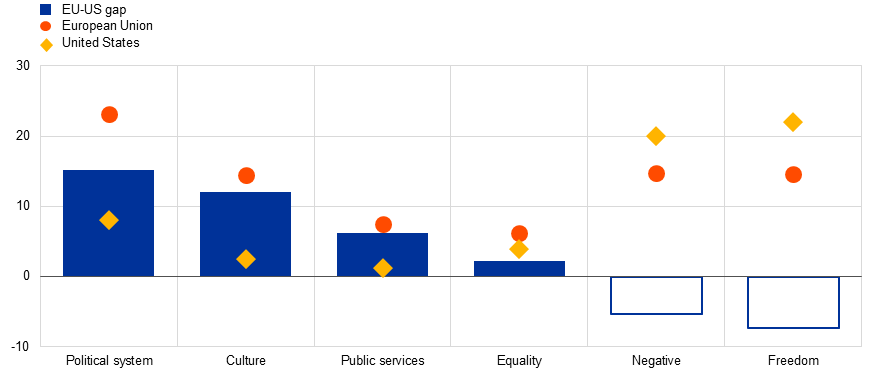
Sources: Pew Research Center and ECB calculations.
Notes: Responses to the Spring 2025 Pew Global Attitudes Survey. EU values are GDP-weighted averages across nine Member States (Germany, Greece, Spain, France, Italy, Hungary, Netherlands, Poland and Sweden). Positive values indicate higher shares in the EU than in the United States. The “Negative” category refers to answers expressing a lack of pride.
A fully harmonised EU framework for company law is difficult to achieve. An optional regime available in parallel with the 27 existing national regimes therefore represents a pragmatic alternative, allowing firms to opt into a common framework while preserving national systems. Three complementary pathways could support its gradual development, including into areas which remain outside the scope of the proposal.
The first pathway is differentiated integration through enhanced cooperation or coalitions of those willing to cooperate among certain Member States.[17] The unitary patent and the Unified Patent Court illustrate how an optional EU-wide framework can emerge where unanimity is otherwise difficult to achieve. For EU Inc., such cooperation could support adjacent modules such as specialised courts, standardised investment documentation and common reporting tools.
The second pathway involves regulatory experimentation through sandboxes or pilot regimes. For EU Inc., this could test whether harmonisation is effective, especially as regards regulation, before the regime is rolled out in full across the EU. The DLT Pilot Regime demonstrates how controlled experimentation with new market infrastructures can coexist with investor protection and financial stability objectives.[18] The proposed EU Inc. framework for corporate law could also helpfully complement technological solutions across Member States.[19] A similar approach to successfully implemented EU-wide sandboxes could be applied to taxation and labour law.
A third pathway is market-led convergence towards voluntary adoption. If EU Inc. proves attractive to young cross-border firms and investors, voluntary adoption could itself drive further integration. Competitive pressure may encourage national authorities to modernise their frameworks, allowing convergence to emerge through the independent adjustment of market practices rather than top-down harmonisation. Over time, this could promote wider convergence beyond firms directly using EU Inc.
5 Concluding remarks
The competitiveness challenge facing Europe is increasingly recognised as a scale-up and internationalisation challenge, but the company law dimension remains largely unaddressed. The coexistence of 27 national company law regimes means that firms expanding across the Single Market continue to face legal fragmentation in establishment, financing, governance and exit.
Against this backdrop, the proposed EU Inc. regime marks an important step towards greater harmonisation of company law. By introducing an optional common corporate framework, it has the potential to reduce legal fragmentation, lower transaction costs and improve the predictability of cross-border corporate activity. It could therefore become an important part of a more integrated European business and investment landscape. However, its full economic benefits will depend on complementary progress under the Single Market and savings and investments union agendas, notably deeper capital market integration and further reductions in regulatory fragmentation.
Experience from other corporate law regimes suggests that the benefits of harmonisation extend beyond the legal text. The effectiveness of a common corporate framework depends on its formal design as well as the legal certainty, market practices and institutional experience that develop around it over time. The ultimate impact of the proposal will depend on whether the legislative process preserves a sufficiently harmonised framework and on whether it is implemented in a manner that is coherent enough to foster a recognised European corporate standard capable of supporting the growth of firms across the Single Market.
EU Inc. is not a silver bullet for the scale-up and internationalisation challenge facing Europe. As an optional regime, its economic impact will depend on the willingness of firms to adopt it and on consistent implementation across Member States. Moreover, the proposal deliberately focuses on company law, so it does not address complementary factors that determine the growth of firms, such as taxation and labour market regulation. Likewise, several constraints that become particularly relevant during the later stages of firms’ development, such as broader insolvency frameworks, the depth of public equity markets and the availability of late-stage growth capital and judicial integration, fall largely outside the scope of the proposal. Negotiations on the EU Inc. regime are ongoing, with the Council of the European Union calling on the co-legislators to reach an agreement by the end of 2026.[20] The final text will help determine whether Europe can create an environment in which innovative firms not only start, but scale up, invest and remain in Europe.
References
Adilbish, O.E., Cerdeiro, D.A., Duval, R.A., Hong, G.H., Mazzone, L., Rotunno, L., Toprak, H.H. and Vaziri, M. (2025), “Europe’s Productivity Weakness: Firm-level Roots and Remedies”, Working Paper No. 2025/040, International Monetary Fund, February.
Alon-Beck, A. (2025), “Incorporating Unicorns: An Empirical Analysis”, Houston Law Review, Vol. 62, Issue 5, pp. 891-952.
Anaya Longaric, P., Bellinghausen, L., Parisi, L., Quaglietti, L. and van Overbeek, F. (2026), “Assessing cross-border integration of equity markets in the euro area: evidence from a gravity model”, Economic Bulletin, Issue 3, ECB.
Andrews, D., Criscuolo, C. and Gal, P.N. (2016), “The Best versus the Rest: The Global Productivity Slowdown, Divergence across Firms and the Role of Public Policy”, OECD Productivity Working Papers, No 2016-5, OECD Publishing, Paris.
Armour, J. and Cumming, D. (2008), “Bankruptcy law and entrepreneurship”, American Law and Economics Review, Vol. 10, Issue 2, pp. 303-350.
Baumann, A., Gati, Z., Vinci, F., Wolf, G. (2026), “Europe’s venture capital gap and the financing of high-growth firms”, Economic Bulletin, Issue 5, ECB.
Bernasconi, R., Cordemans, N., Gunnella, V., Pongetti, G. and Quaglietti, L. (2025), “What is the untapped potential of the EU Single Market?”, Economic Bulletin, Issue 8, ECB.
Bothner, J., Lopez-Garcia, P., Momferatou, D. and Setzer, R. (2026), “Why is Europe lagging behind in high tech sectors? The role of institutional and regulatory quality”, Working Paper Series, No 3185, ECB.
Broughman, B., Fried, J. M. and Ibrahim, D. (2014), “Delaware Law as Lingua Franca: Theory and Evidence”, The Journal of Law and Economics, Vol. 57, No 4, pp. 865-895.
Böninghausen, B., Evrard, J., Gati, Z., Gori, S., Lambert, C., Legran, D., Schuster, W.E. and van Overbeek, F. (2025), “Should we mind the gap? An assessment of the benefits of equity markets and policy implications for Europe’s capital markets union”, Occasional Paper Series, No 373, ECB.
Cary, W. L. (1974), “Federalism and Corporate Law: Reflections upon Delaware”, The Yale Law Journal, Vol. 83, No 4, pp. 663-705.
Cipollone, P. (2026), “Building the rails for Europe’s tokenised financial markets”, keynote speech at an event on “Building Europe’s integrated digital asset ecosystem: from vision to implementation” hosted by the House of the Euro, Brussels, 23 March.
Coatanlem, Y. and Coste, O. (2025), “Cost of Failure, Disruptive Innovation and Targeted Flexicurity: more evidence supporting targeted reforms”, IEP@BU Working Paper Series, Bocconi University.
Christelis, D., Georgarakos, D., Jappelli, T., Kenny, G. and Meyer, J. (2026), “Stockholding in Europe: Evidence from the Consumer Expectations Survey”, Working Paper Series, No 3239, ECB.
Christelis, D., la Franca, I., Georgarakos, D., Jappelli, T., Kenny, G. and Meyer, J., (2026), “Why do euro area consumers (not) invest in stocks?”, SUERF Policy Brief, No 1518, SUERF.
CompNet (2025), “Firm Productivity Report”, April.
Dizioli, A., Fotiou, A. and Garrido, J.M. (2026), “Toward a 28th European Enterprise Regime: A Single Rulebook to Enable Cross-Border Scale-Up in Europe”, Departmental Paper Series, No 2026/014, International Monetary Fund.
Draghi, M. (2024), “The future of European competitiveness”, European Commission, September.
European Banking Authority (2025), “Call for advice for the purposes of benchmarking of national loan enforcement frameworks (Final report)”, October.
European Investment Bank (EIB) (2026a), “Drivers of relocation by innovative EU startups and scaleups”.
European Investment Bank (EIB) (2026b), “EIB Investment Report 2025/2026”.
Eurosystem work stream on productivity, innovation and technological progress (2021), “Key factors behind productivity trends in EU countries”, Occasional Paper Series, No 268, ECB.
Fedotenkov, I. and Vandeplas, A. (2026), “Demographic Change and Business Dynamics in the EU”, European Economy Discussion Papers, No 251, European Commission.
Fuest, C., Gros, D., Mengel, P.-L., Presidente, G. and Tirole, J. (2024), “EU Innovation Policy: How to Escape the Middle Technology Trap”, ifo Institute.
Gelter, M. (2017), “Centros, the Freedom of Establishment for Companies and the Court’s Accidental Vision for Corporate Law”, in F. Nicola and B. Davies (eds.), EU Law Stories: Contextual and Critical Histories of European Jurisprudence, Cambridge University Press, pp. 309-337.
Klepper, S. (1996), “Entry, Exit, Growth, and Innovation over the Product Life Cycle”, American Economic Review, Vol. 86, No 3, pp. 562-583.
Letta, E. (2024), “Much more than a market – Speed, Security, Solidarity: Empowering the Single Market to deliver a sustainable future and prosperity for all EU citizens”, April.
OECD (2021), “Understanding Firm Growth: Helping SMEs Scale Up”, OECD Studies on SMEs and Entrepreneurship, OECD Publishing, Paris.
OECD (2026), “OECD Compendium of Productivity Indicators 2026”, OECD Publishing, Paris.
Schnabel, I. (2026), “Made in Europe”, speech at a lecture in memory of Eugen Böhm von Bawerk, Österreichische Akademie der Wissenschaften, Vienna, 11 February.
Whitehead, C.K. (2025), “Delaware’s Agency Problem”, Cornell Legal Studies Research Paper Series, No 25-25, Cornell University Law School, August.
Weik, S., Achleitner, A.K. and Braun, R. (2024), “Venture capital and the international relocation of startups”, Research Policy, Vol. 53, Issue 7.
Wunsch P. and Langenus G. (2026), “Eurosclerosis 2.0 in a Changing World: From Repetition to Rupture”, Policy Paper, Nationale Bank van België/Banque nationale de Belgique.
Legal Disclaimer:
EIN Presswire provides this news content "as is" without warranty of any kind. We do not accept any responsibility or liability for the accuracy, content, images, videos, licenses, completeness, legality, or reliability of the information contained in this article. If you have any complaints or copyright issues related to this article, kindly contact the author above.
